Calpi Parish



What you should know?
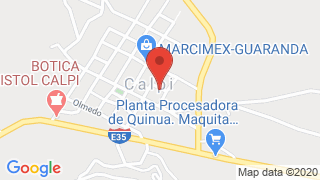
Calpi Parish is located 10 km (about 6.2 miles) from the city of Riobamba, right next to the Pan-American Southern Highway.
To get to the parish, you must take Riobamba's urban bus line 16.
It is a very remote town. Groups such as the Calpi or Cápac settled here.
For several years now, about 80 families have lived in Calpi, dedicated to farming. From their harvests, they obtain foods such as grains and tubers for their daily meals. For some time now, the community has also focused on raising llamas and alpacas. Their skins are used to protect against the cold of the Andean paramo; their meat is used to prepare delicious recipes for food, and from their wool, artisans skillfully make clothing and textile crafts. This actively boosts the community's economy.
Tourist Attractions in Calpi
Calpi Church
This attraction is located in the central area of Santiago de Calpi, in front of the parish's main park.
Its façade features the unmistakable Gothic and Neo-Gothic style. On the front plane, the elevation of four columns (without capitals) stands out, supporting the three bodies (lower, middle, and upper). At the upper ends, two octagonal towers crown the structure.
On the lower body of the façade, between the columns, there are three front gateways, with the main entrance standing out for its larger dimensions. Above the doors, pointed ogival arches with Gothic archivolts stand out, featuring flat tympanums, each adorned at the top with straight archivolts forming a triangle. On either side, there are two circular windows, except for the main entrance, whose sharp vertex extends up to the second body.
In the middle body, there are three ogee arches, each distributed between two columns. The ones on the ends are elongated and contain the stained-glass windows. The central ogee arch is not very long and extends from the cornice built over two trefoils.
A rose window is located in the tympanum of the central arch. Two pillars that start from the central ogival arch of the lower body end in pinnacles attached to the façade.
On the upper body of the façade, two octagonal towers stand out, each adorned with rose windows, and their vertices end in pinnacles.
At the back of the temple, where the main altarpiece is located, a dome stands out. This dome rises from a structure made up of eight walls, each featuring a trefoil window for lighting and a straight, roof-like finish.
Alongside the main vault, two secondary vaults extend, featuring ogee arches with rosettes on their sides.
The temple has no side doorways but does include five ogival arch-style windows on each side, distributed between the columns that run from the façade section to the back and end in pinnacles. Its five straight flying buttresses (on each side), anchored to its low-height buttresses, are also noteworthy.
The apse bases its structure on interior ribs formed by pointed cross arches; former arches lead to the lateral vaults.
Its construction began in 1958 and was completed around the 1980s, thanks to the contributions of the parish's residents. The Gothic architecture and the dimensions of the building are its most outstanding features.
Inside the temple, the layout of the naves and the images of the parish's patron saint stand out in this described building. You can visit the church every day, and if it is closed, you can coordinate with the parish priest to have it opened.
Colonial Church of Calpi
This attraction is located in the central area of Santiago de Calpi, facing the main park and next to the parish church.
With an undefined style but leaning towards Colonial Baroque tendencies, its simple façade represents the austerity of its construction. It consists of two bodies that end in two towers and an obtuse angle at the peak of the gabled roof.
The lower body features a carved stone façade, smooth and without decorative inlays. It has a semicircular arch that houses the only entrance door to the temple's main nave. Six columns with capitals, whose equine abaci and collars are straight, resembling those of the Doric style.
The upper body ends in two towers, each containing a semicircular arch that houses a belfry. The roof is a hip roof, with a cross rising from its upper vertices.
The central obtuse vertex features a semicircular arch on its lower part, which is purely decorative. On the sides, it has four rectangular windows and no side doorways.
Vernacular architecture characterizes this construction, which stands out for its stone façade. Inside, a baptismal stone stands out, which has remained since the construction of the parish's first temple. The interior is not very flashy, highlighting its carved wooden supports (columns).
Currently, the temple is available to the parish and to those who, with devotion to the parish's patron saint, wish to enter. It is recommended to request the proper authorization from the ecclesiastical administration. Religious ceremonies are held every weekend.
Llama Culture Museum
This attraction is located in the Palacio Real community, in the eastern sector of the Santiago de Calpi parish.
Access is reached at kilometer 15 of the road to San Juan, via the paved road that connects the parish seat with the Palacio Real community.
The llama-themed museum alludes to this Andean camelid and its historical and current importance. It is composed of several sections, highlighting the morphological illustration of Andean camelid species; the sacrificial rites of llamas in the pre-Inca, Inca, and Spanish conquest phases; the agricultural calendar dates for camelids; ancestral and current uses; and graphic illustrations of ceramics and figurines based on the llama.
Telempala Viewpoint
The Telempala Viewpoint is located 5 km from the parish seat, at the northwestern end of Calpi, 12 km from Riobamba, and 1.5 km from the San Juan parish seat.
Access to the community is via the paved road that leads from the Cemento Chimborazo company sector to the Chiquicaz community. From the latter, you must travel a gravel stretch of approximately 1 km.
The natural viewpoint is located in the community's town center. The main productive activity here is agriculture, with notable crops of peas (Pisum sativum), oats (Avena sativa), barley (Hordeum vulgare), fava beans (Vicia faba), mashua (Tropaeolum tuberosum), potatoes (Solanum tuberosum), and quinoa (Chenopodium quinoa).
Reaching an altitude of 3,516 meters above sea level (masl), the visual field towards the Chimborazo snow-capped volcano is wide and almost unobstructed, making it an excellent viewpoint that extends to all cardinal points. It is the highest point in the northeast area of the Calpi parish. The continuous presence of the star hummingbird (Oreotrochilus stella) stands out.
From the community, you can also access the Telempala and Chiquicaz paramo through a trail approximately 3 km long. To reach an altitude of 3,956 masl, you must walk through grasslands that reach up to 60 centimeters in height. There are no trails to reach this altitude, which is the highest point in the Calpi parish. From here, you can also observe the Colta Lagoon and the town of Cajabamba, without losing the wide view of the Chimborazo snow-capped peak, the communities of Calpi parish, part of the city of Riobamba, and the main snow-capped mountains and volcanoes surrounding the Tapi valley.
Mountain Museum
In the La Moya community, a museum, a handicraft store, and two interpretive trails have been set up. Additionally, there is the possibility of extending along a trail that includes an ascent to a paramo ecosystem. The adaptation of houses to operate as community lodges is currently in the project phase.
The association Urkukunapak Wasi (House of the Mountains) welcomes tourists visiting the community, and its main attraction is the Mountain Museum.
It is a thematic museum that combines ancestrally used Andean elements and oral tradition passed down through generations, especially the legends of the mythical mountains of northern Chimborazo province. Tools and utensils for daily use, community clothing, and the work of the Chimborazo ice merchants (hieleros) are also exhibited.
The elements integrated into the museum are agricultural and domestic utensils, each with its respective translation in Kichwa. It features a thematic mural about the legends of the province's main snow-capped peaks. A construction resembling a typical Andean dwelling and its internal divisions also stands out. Another important section illustrates the figure of the Chimborazo ice merchant. At one end of the museum, a passage has been adapted to characterize the Templo Machay (Cave Temple), incorporating the most relevant aspects of that legend.
In La Moya, a natural viewpoint has been identified, allowing a direct visual plane towards the Chimborazo snow-capped peak. Although not much representative flora and fauna are observed, the landscapes allow visitors to appreciate various elements such as the importance of the paramo, the Chimborazo Fauna Reserve, cultivation methods (on terraces), in addition to strengthening environmental education and the importance of the Ecuadorian paramo in visitors. There are limited areas of grassland paramo, so it is necessary to take action to protect these areas and recover others that are being threatened by agricultural crops advancing from the San Juan parish, which have already reached the parish boundary.
Mira Loma Viewpoint
This attraction is located in the Palacio Real community and stands out as the most notable elevation in the area.
It is a natural viewpoint at an altitude of approximately 3,750 masl. Here you can go on hikes to learn about the native flora and fauna of the area, such as cypress, capulí, and eucalyptus trees, cabuya, chilca, llinllin, retama (broom), and thorn bushes.
You can also observe different bird species such as turtledoves, blackbirds, and other songbirds. From a privileged vantage point, you can see the majestic Chimborazo, Carihuairazo, Tungurahua, El Altar, and Sangay volcanoes.
There are no restrictions to visit the attraction, but it is recommended that visitors coordinate with the guides of the Palacio Real community.
Simón Bolívar Estate
This attraction is located in the Palacio Real community. To get there, you must follow part of the road leading to Calpi and then take a detour along a trail of about 500 meters until you reach the site.
The "Simón Bolívar Estate," built in the year 1720 with uncut black stones joined with mud to raise its walls, belonged to the Valencia family.
This is the oldest estate in the area. According to several residents of the rural parish of Santiago de Calpi, it was the lodging place of the Liberator Simón Bolívar on several occasions before he ascended the colossal Chimborazo volcano, to which he would later write his poem "My Delirium on Chimborazo" (Mi Delirio sobre el Chimborazo).
This story also explains the characteristic name of the community, as traditional accounts say that the locals asked him how he had slept, and he replied that he had slept as if in his palace (palacio), thus giving rise to the name Palacio Real (Royal Palace).
Piedra Endiablada (The Devilish Stone)
This attraction is located in the Palacio Real community. To get there, you must follow part of the road leading to Calpi and then take a detour along a trail called Simón Bolívar, about 500 meters long, until you reach the site.
The Piedra Endiablada is a rock formation shaped like a pond. In ancient times, rainwater was collected from this stone.
Legend has it that once they tried to move it but failed because it started to rain and the people began to suffer headaches. Nowadays, the local people hold great respect for this stone.
Individual attractions that comprise it: The Simón Bolívar Estate and the Chacana square.
There is no permit or restriction required, but it is recommended to coordinate with the people of the Palacio Real community for guidance to make the most of your visit.
Community Tourism in Calpi
Quilla Pacari Community Tourism Center
This attraction is located in the San Francisco de Cunuguachay community, in the Calpi parish.
The "QUILLA PACARI" Community Tourism Operation is situated in the San Francisco de Cunuguachay community, Calpi Parish, Riobamba Canton, Chimborazo Province. Its name in Spanish means "DAWN MOON" (Luna del Amanecer).
Located 18 kilometers from the capital city of Riobamba, it enjoys a pleasant climate. Its average temperature ranges between 10 and 15°C, with fresh mornings and somewhat cold nights. It is at an altitude of 3,265 masl.
Quilla Pacari is a model alternative project, integrated by a group of women seeking the well-being of their families and the community in general. Its activities include community coexistence, bike rides, traditional Andean medicine, craft-making, and cultural events, promoting an unexpected encounter with the indigenous Puruhá people.
In addition to promoting Community Tourism, they carry out alternative production projects in their surroundings, including a factory for jams of different flavors prepared with carrots, a wool hat workshop, and bakeries, among others, which complement the daily life of the community.
La Moya Community Tourism Center
This is a community located 22 kilometers from Riobamba, a beautiful city and capital of the province. It sits at 3,250 meters above sea level, with temperatures ranging between 6°C at night and 19°C during the day.
The community has a population of approximately 196 inhabitants, made up of 45 families, with the most numerous being Buñay, Miñarcaja, Puma, Paucar, Lema, and Concha. This population is descended from the Puruhá people.
The name La Moya comes from the valley where the community is settled. The Romero and Moyano families used to live in this valley, and the community took its name from the latter (Moyano).
Until the 1980s, the residents of this community were Ice Merchants (Hieleros) of Chimborazo, who are the protagonists of the documentary about the Chimborazo ice merchants made by the Guayasamín brothers. With the aim of revaluing their history, the La Moya community has organized over the past two years to undertake Community Tourism activities, currently offering two interpretive trails, the museum about the mountains called Urkukunapak Wasi, and a handicraft room where crafts made by the skilled hands of the community's women are displayed.
Palacio Real Community Tourism Center
This attraction is located in the Palacio Real community, at kilometer 15 of the road to San Juan. Geographically, it is located in the Calpi Parish, Riobamba Canton, Chimborazo Province.
Made up of 80 families dedicated to agriculture, livestock, and handcraft-making, it is at an altitude of 3,200 masl. The community enjoys a pleasant climate, with temperatures between 15 and 18°C during the day and 8°C at night.
The Palacio Real community, with its Community Tourism Operation Sumak Kawsay (Good Living), showcases their community way of life. This product is developed around an Andean camelid: the llama.
They have signposted trails leading to their natural attractions (Simón Bolívar trails and the Mira Loma path) as well as to their productive projects (the Llama Museum, and spinning workshops for llama, alpaca, and sheep wool).
Their native guides share with visitors the legends of the Puruhá culture, historical data about the community, ancestral practices, and environmental interpretation.
Sumak Kawsay has a differentiating feature: a restaurant specializing in llama meat called "El Palacio de la Llama" (The Palace of the Llama), where they offer national and international tourists exquisite dishes prepared with llama meat, thus guaranteeing good and nutritious food. Additionally, it has an area for selling handicrafts, adding variety to the activities tourists can enjoy.
Festivities in Calpi
-
February / March – Carnival Festivities.
-
March / April – Holy Week.
-
August – Festivities in Honor of the Patron Saint San Agustín (St. Augustine) (La Moya).
-
November – Feast of the Patron Saint of the parish, Santiago de Calpi (St. James of Calpi), and the Parish Foundation Anniversary.
Contacts
-
E-mail: santiagodecalpi2019@gmail.com
-
WhatsApp: +593985558574
Publicado en:
Keep exploring the rural parishes of Riobamba
Publicado por: